


All content on this site is intended for healthcare professionals only. By acknowledging this message and accessing the information on this website you are confirming that you are a healthcare professional.

  TRANSLATE

The Lupus Hub website uses a third-party service provided by Google that dynamically translates web content. Translations are machine generated, so may not be an exact or complete translation, and the Lupus Hub cannot guarantee the accuracy of translated content. The Lupus Hub and its employees will not be liable for any direct, indirect, or consequential damages (even if foreseeable) resulting from use of the Google Translate feature. For further support with Google Translate, visit Google Translate Help.

The Lupus Hub is an independent medical education platform, sponsored by Autolus, Biogen and Biogen MA, Inc. and UCB. Funders are allowed no direct influence on our content. The levels of sponsorship listed are reflective of the amount of funding given. View funders.

Now you can support HCPs in making informed decisions for their patients

Your contribution helps us continuously deliver expertly curated content to HCPs worldwide. You will also have the opportunity to make a content suggestion for consideration and receive updates on the impact contributions are making to our content.

Find out more

Masterclass | CAR T-cell therapy: Redefining the management of lupus

By Haimanti Mandal

Share:

Featured:

David JayneDavid JayneDavid IsenbergDavid IsenbergRuth PepperRuth Pepper

Nov 17, 2026

Learning objective: After reading this article, learners will be able to describe the rationale for CAR T-cell therapy in lupus, emerging clinical evidence, and key considerations for its implementation in rheumatology practice.


The treatment landscape in systemic lupus erythematosus (SLE) continues to evolve; however, unmet needs remain in achieving deep and durable disease control, minimizing glucocorticoid exposure, and preventing irreversible organ damage, particularly in patients with refractory disease. Chimeric antigen receptor (CAR) T-cell therapy has emerged as a promising investigational approach, with the potential to achieve deep depletion of pathogenic B-cell populations and restore immune homeostasis. 

The Lupus Hub spoke with David Isenberg, David Jayne, and Ruth Pepper to discuss the scientific rationale for CAR T-cell therapy in lupus and the emerging clinical evidence for this therapeutic approach, including recent findings with obecabtagene autoleucel. The discussion also explored key considerations for adapting established CAR T-cell treatment pathways from oncology to rheumatology practice and the importance of a multidisciplinary approach. 

The rationale for CAR T-cell therapy in lupus

The rationale for CAR T-cell therapy in lupus

The Lupus Hub was pleased to speak with David Isenberg, University College London Hospitals NHS Foundation Trust (UCLH), London, UK. We asked, What is the rationale for treating lupus with CAR T-cell therapy?

Obecabtagene autoleucel in lupus: Evidence and ongoing trials

Obecabtagene autoleucel in lupus: Evidence and ongoing trials

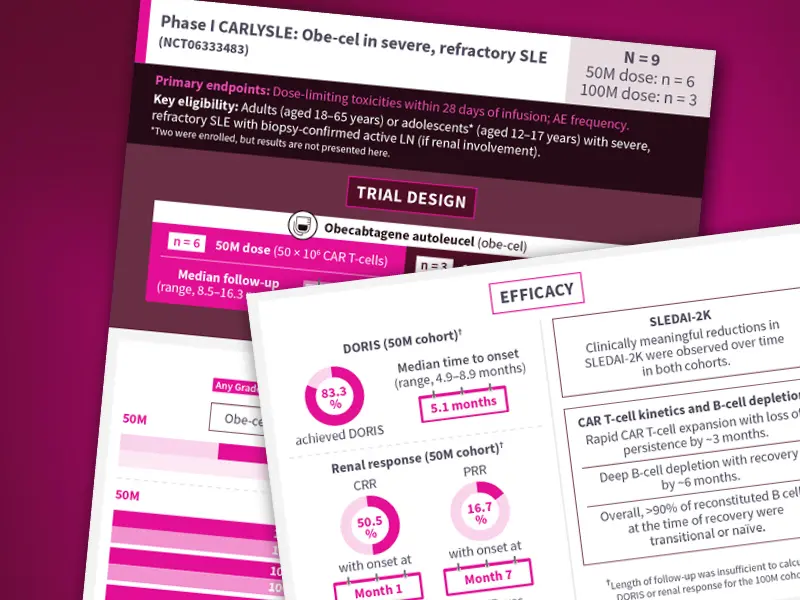
The Lupus Hub was pleased to speak with David Jayne, University of Cambridge, UK. We asked, What is the current evidence supporting obecabtagene autoleucel for the treatment of lupus, and what clinical trials are ongoing?

Adapting oncology CAR T-cell therapy pathways for rheumatology

Adapting oncology CAR T-cell therapy pathways for rheumatology

The Lupus Hub was pleased to speak with Ruth Pepper, Royal Free Hospital and University College London Hospitals NHS Foundation Trust (UCLH), London, UK. We asked, How can established oncology CAR T-cell therapy pathways be adapted for rheumatology?

This educational resource is independently supported by Autolus. All content is developed by SES in collaboration with an expert steering committee. Funders are allowed no influence.   

Please indicate your level of agreement with the following statements:

The content was clear and easy to understand

The content addressed the learning objectives

The content was relevant to my practice

I will change my clinical practice as a result of this content

This content is accurate as of the date of publication and is not updated retrospectively. Please refer to the latest available evidence, guidelines, and relevant regulatory information when making clinical decisions.