All content on this site is intended for healthcare professionals only. By acknowledging this message and accessing the information on this website you are confirming that you are a healthcare professional.
The Lupus Hub website uses a third-party service provided by Google that dynamically translates web content. Translations are machine generated, so may not be an exact or complete translation, and the Lupus Hub cannot guarantee the accuracy of translated content. The Lupus Hub and its employees will not be liable for any direct, indirect, or consequential damages (even if foreseeable) resulting from use of the Google Translate feature. For further support with Google Translate, visit Google Translate Help.


The Lupus Hub is an independent medical education platform, sponsored by Autolus, Biogen and Biogen MA, Inc. and UCB. Funders are allowed no direct influence on our content. The levels of sponsorship listed are reflective of the amount of funding given. View funders.
Now you can support HCPs in making informed decisions for their patients
Your contribution helps us continuously deliver expertly curated content to HCPs worldwide. You will also have the opportunity to make a content suggestion for consideration and receive updates on the impact contributions are making to our content.
Find out more
Create an account to access:
Bookmark & personalize site content
Receive alerts for new content in your areas of interest
View lupus content recommended for you
What are the implications of the PHOENYCS GO trial for the SLE treatment landscape?
Featured:
 Zahi Touma
Do you know... In the phase III PHOENYCS GO trial, dapirolizumab pegol significantly improved the primary endpoint of a British Isles Lupus Assessment Group (BILAG)-based Composite Lupus Assessment (BICLA) response at Week 48. Which response rates were observed with dapirolizumab pegol vs placebo?
The Lupus Hub was pleased to speak with Zahi Touma, University of Toronto and University Health Network, Ontario, CA. We asked, What are the implications of the PHOENYCS GO trial for the SLE treatment landscape?
During this interview, Touma discusses the unmet need for therapies that provide broad and durable disease control in systemic lupus erythematosus (SLE) while minimizing glucocorticoid exposure, the mechanism of action of dapirolizumab pegol as a CD40 ligand (CD40L) inhibitor, and the clinical evidence supporting its development. He highlights findings from the phase III PHOENYCS GO trial (NCT04294667), including achievement of the primary endpoint and improvements across multiple measures of disease activity, disease control, fatigue, and glucocorticoid tapering, as well as an acceptable and manageable safety profile. Touma also discusses the ongoing PHOENYCS FLY trial (NCT06617325), which may further establish the role of dapirolizumab pegol in patients with moderate-to-severe disease.
What are the implications of the PHOENYCS GO trial for the SLE treatment landscape?
Key learnings
- Despite the availability of approved therapies, including belimumab and anifrolumab for SLE, and voclosporin and obinutuzumab for lupus nephritis, an unmet need remains for therapies that provide broad and durable disease control while improving patient-reported outcomes and minimizing glucocorticoid exposure.1
- Dapirolizumab pegol is a novel CD40L inhibitor comprising a polyethylene glycol (PEG)-conjugated antigen-binding fragment without an Fc domain. By blocking the CD40–CD40L interaction, it reduces B- and T-cell activation and downregulates the type I interferon pathway and other cytokine pathways involved in SLE immunopathology.1
- Early clinical evidence supported further evaluation of dapirolizumab pegol. Although the phase II trial (NCT02804763) did not meet its primary endpoint of establishing a dose–response relationship, findings across multiple clinical and immunological measures of disease activity supported progression to phase III development.2
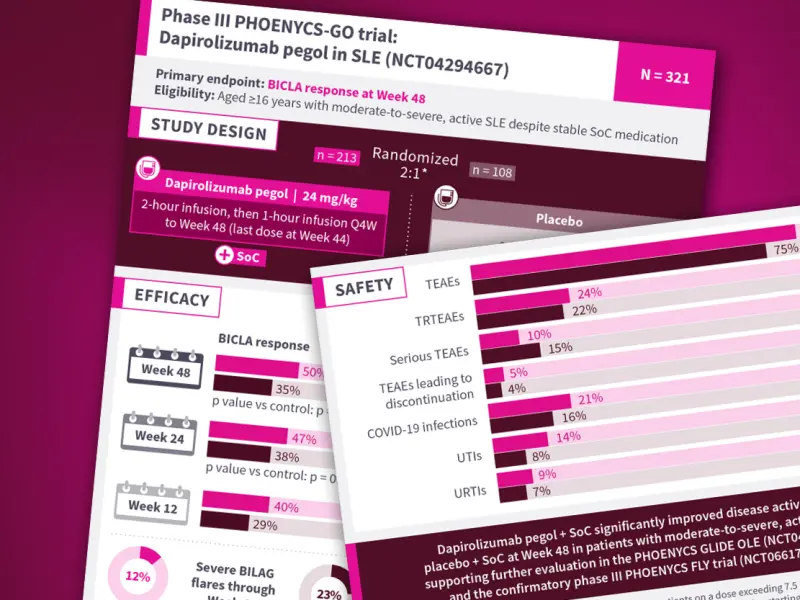
- PHOENYCS GO (NCT04294667) was a 48-week, randomized, double-blind, placebo-controlled phase III trial evaluating dapirolizumab pegol 24 mg/kg vs placebo, both in addition to standard-of-care, in patients with active, moderate-to-severe SLE.1
- The primary endpoint was met, with a significantly greater proportion of patients receiving dapirolizumab pegol achieving a British Isles Lupus Assessment Group (BILAG)-based Composite Lupus Assessment (BICLA) response at Week 48 compared with those receiving placebo (50% vs 35%; p = 0.011).
- Improvements were observed across secondary outcomes, including prevention of severe BILAG flares, reductions in SLE Disease Activity Index-2K (SLEDAI-2K) scores, higher SRI-4 response rates, greater achievement of Lupus Low Disease Activity State (LLDAS), and reduction of glucocorticoid dose.
- Patient-reported fatigue also improved, as measured by the Functional Assessment of Chronic Illness Therapy (FACIT)–Fatigue scale.
- Safety findings were generally consistent with those of previous studies. Treatment-emergent adverse events (TEAEs) were reported more frequently with dapirolizumab pegol than with placebo, whereas serious TEAEs were less frequent in the dapirolizumab pegol group.
- Findings from the PHOENYCS GO trial support further investigation of CD40L inhibition as a therapeutic strategy for SLE and the continued development of dapirolizumab pegol as a potential treatment option for patients with moderate-to-severe disease.1
- The confirmatory phase III PHOENYCS FLY trial (NCT06617325) is underway to further evaluate the efficacy and safety of dapirolizumab pegol in moderate-to-severe SLE.1
- In conclusion, Touma highlights the relevance of PHOENYCS GO to routine clinical practice, noting its geographically diverse patient population and improvements across multiple aspects of SLE. He adds that positive findings from PHOENYCS FLY could support regulatory approval of dapirolizumab pegol, potentially expanding treatment options and reducing glucocorticoid use and associated long-term damage.
This educational resource is independently supported by Biogen MA, Inc. and UCB. All content is developed by SES in collaboration with an expert steering committee. Funders are allowed no influence.
References
Please indicate your level of agreement with the following statements:
The content was clear and easy to understand
The content addressed the learning objectives
The content was relevant to my practice
I will change my clinical practice as a result of this content
This content is accurate as of the date of publication and is not updated retrospectively. Please refer to the latest available evidence, guidelines, and relevant regulatory information when making clinical decisions.
Your opinion matters
In which area of SLE management would additional medical education be most valuable to support your clinical practice?